

Thursday, May 2, 2013

Wednesday, April 10, 2013
Whales in Iceland
Here are some fantastic pictures sent to us by Sammie Haines upon her return from a recent trip to Iceland.


Some recent fantastic feedback from some of our customers


Many many thanks
J & P Williams April 2013

Just a few words to tell you that our trip in March in
Kenya, in the adventure camp in Ol Kinyei Conservancy was very nice.
Everything was well organised and everybody was nice everywhere. But best of all was our stay in the adventure camp in ol Kinyei Conservancy. We spent 8 wonderful days with our guides and the team of the camp. It could not have been better !
We had a wonderful time over there, we saw more animals
than we could have imagined and all the people were very friendly. Our daughters
loved it. The most difficult was to come back !
All the best.
S O'Donnell April 2013
|
|
|
|
Tuesday, March 12, 2013
Fantastic feedback from our recent Discover Wildlife Photography evenings with the inspirational Nick Garbutt!


It was so interesting hearing Nick’s take on the
whole new concept of ‘photography’ that is digital. I actually feel a new name should be created for
the images that are passed as photographs. It was great to meet Chris Breen having ‘bumped’
into him in the Luangwa Valley many years ago (as you do!!). We talked of a possible trip later this year.
shall be in touch about that when the present dust settles. Thank you once again for a very good evening.
(please pass on our thanks to Chris and Nick).
Kind regards, Lesley
Enjoyed
the evening very much. Great to talk to everyone. Certainly got
Sarah and I thinking about another trip
with you. Please would you send me details of the Baja California trips
in 2014!!
Valerie
It was a great evening. Good seeing Chris again and meeting Brian (with
whom I'd spoken on the phone in relation to a project we were running last
year). Nick Garbutt was fascinating - an evening very well spent!
All
the best,TomJust a quick line to say that the meet NickGarbutt night was even better than I had expected, great night.
Many thanks, Duncan
I thought that the meeting was a
great success - all my friends enjoyed it a great deal. Many thanks for
organising it. Nick's presentation was just outstanding. I was often smiling
when I saw pictures which were taken when I was with him in Africa or
Brazil!
Best wishes, Charles
I thought the wildlife Photography evening was very enjoyable.
Nick Garbutt gave lots of good advice regarding my forthcoming trip
and was a very interesting person to listen to.
Although I've already made plans to visit Madagascar for a third time this
october, I would strongly consider a wildlife trip with Nick in the
near future. Am I right in thinking he runs a trip to Borneo ? I'm also
interested in Papua New Guinea.
Kind regards, Stephen
Kind regards, Stephen
Monday, July 30, 2012
Bernie
Reichert travelled with Wildlife Worldwide on the Brown
Bear Explorer trip to Finland in June
2012. Read an account of his trip and check out his fantastic pictures!

Arrived in Kajaani in the evening. My sort of airport - one room and only a short wait for our bags. We were taken straight to Viiksimo where dinner had been prepared by a cook who really cared about how his "customers" enjoyed the food.


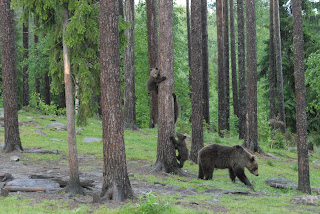
 Join a small group departure for the Brown Bear Explorer trip in June, July and August, or let us tailor-make to suit your preferences. The 8-day group departure costs from £1,310 per person (land only). Find out more at http://www.wildlifeworldwide.com/holiday/group_brown_bear_explorer_wfbt.html or call us on 0845 130 6982.

Arrived in Kajaani in the evening. My sort of airport - one room and only a short wait for our bags. We were taken straight to Viiksimo where dinner had been prepared by a cook who really cared about how his "customers" enjoyed the food.
Next morning we had our first nature
walk - that taught us to put on mosquito repellent whenever outside!
Wellies would have been a good idea, too, although most of us managed to keep
our feet dry in our walking boots. That night was spent in the hide. The first
wolf arrived at 7:20 pm, and we had a total of three visits by a group of
3 wolves. Since there are only about 150 wolves in all of Finland, we counted
ourselves lucky! The (only) bear came about 3:30 am and made a circuitous pass
around the area in front of the hide.

Next night in the same hide - this
time we had a "watch roster" and since it was fairly quiet
animal-wise we mostly got a reasonable night's sleep. The same (apparently)
bear came twice, the first time being chased away by another (territorial)
bear.
Next day it was off to
Martinselkonen and the day after we had a night in the main hide there, this
time in a patch of forest. Bears everywhere right from the off. Among bears,
"might is right" and the youngsters quickly scuttled up a tree when a
larger bear came along. There was a bear with 4 cubs, the two smallest of
which spent much of the time up a tree! Also saw a black kite and
white-tailed sea eagle. By midnight we'd had almost 7 hours of virtually
nonstop bears, so most of us got a good sleep.

For the second night of bear
watching at Martinselkonen, a few of us chose to spend the night in small 1-2
person hides. Not much comfort but a real sense of adventure - after being
taken to the hide, we locked ourselves in for a night among the bears! Some
bears came as close as a few metres from the hides and allowed very close
views/photos. Even saw the mosquitos buzzing around their noses!

On the last full day, I was the only
one who chose to do the rowboat trip on a nearby scenic lake, so I had my
personal rower! (although I did help steer when she was getting tired on the
return leg). A very pleasant few hours helped by the fact that it was the only
sunny day of the tour. We even got a (distant) view of a bear in the
surrounding forest, looking at the strange thing on the lake! That evening we
went to an "evening hide" where we stayed for only a few hours to let
us have good nights sleep before travelling home. So about 10 pm we scuttled
back to the car park after a couple of big bears had ambled off and got
into "proper bed" bed before the trip back to London the next
day.

Tuesday, July 24, 2012
Exciting news in from the lion relocation project in Malawi.
We have some very interesting and exciting news in from the Mkulumadzi lion relocation project in Malawi.
Recently the boys had been selected and collared, and the girls were about to be picked from the crowd as well, this has now all happened and we they have moved on to the next step. They were selected from a completely different pride to ensure maximum genetic diversity, which in the future will hopefully (all fingers and paws crossed) ensure that there will be a viable lion population after relocation.
 On the 18th June the boys and girls were all to be captured at exactly the same time and moved to the boma. It was crucial that this all went smoothly and in unison so that all 4 of them would meet together after groggily waking up in the boma. However, as we all know the best laid plans never do go smoothly, and as the teams set out, the first male was located by his radio collar so deep into the bush that there was no way that a car was getting to him! What to do?! Well
helicopters were the only option for him so the aerial team got under way, darted the bush boy and somehow managed to get him to the car before the road team headed off looking for
the second male.
 It turns out that this guy was a bit of a show off and was posing for a multitude of tourists cameras on a fresh kill by the side of the road. Showing his better side to the tourists he happily lapped up the attention. After everyone was happy, the veterinary teams spoke to the tourists to see if they wanted to witness the darting of a wild animal and have first hand experience of conservation, which of course they all did! This time, everything went very smoothly and before they knew it both boys were bumbling along to their boma.
 The ladies were of course a lot easier, as would be expected! And all four beasts woke up together in the boma slightly flustered and disorientated to start with but have bonded well and doing fine. Enjoying the room service almost immediately! The new family are having a blast and will be heading for Malawi on the 30th July.
So there we go. We will update you with the next instalment as soon as we get it!
Of course at Wildlife Worldwide (together with Robin Pope Safaris) we would be very happy to help you experience Mkulumadzi and the lion relocation project in action.
We have been working with Robin Pope Safaris for 20 years or more and together with its operations in Malawi at Mkulumadzi in Majete Game Reserve and Pumulani on the shores of Lake Malawi, there are four beautiful camps scattered across the Luangwa Valley – Nkwali, Luangwa River Lodge, Tena Tena and Nsefu. They vary in size from Nkwali and Nsefu which each accommodate 12 guests, to Tena Tena which accommodates eight people and Luangwa Rover Lodge which accommodates ten.
DO ask us for more information and to put an itinerary together for you.

Recently the boys had been selected and collared, and the girls were about to be picked from the crowd as well, this has now all happened and we they have moved on to the next step. They were selected from a completely different pride to ensure maximum genetic diversity, which in the future will hopefully (all fingers and paws crossed) ensure that there will be a viable lion population after relocation.
On the 18th June the boys and girls were all to be captured at exactly the same time and moved to the boma. It was crucial that this all went smoothly and in unison so that all 4 of them would meet together after groggily waking up in the boma. However, as we all know the best laid plans never do go smoothly, and as the teams set out, the first male was located by his radio collar so deep into the bush that there was no way that a car was getting to him! What to do?! Wellhelicopters were the only option for him so the aerial team got under way, darted the bush boy and somehow managed to get him to the car before the road team headed off looking for
the second male.
It turns out that this guy was a bit of a show off and was posing for a multitude of tourists cameras on a fresh kill by the side of the road. Showing his better side to the tourists he happily lapped up the attention. After everyone was happy, the veterinary teams spoke to the tourists to see if they wanted to witness the darting of a wild animal and have first hand experience of conservation, which of course they all did! This time, everything went very smoothly and before they knew it both boys were bumbling along to their boma.The ladies were of course a lot easier, as would be expected! And all four beasts woke up together in the boma slightly flustered and disorientated to start with but have bonded well and doing fine. Enjoying the room service almost immediately! The new family are having a blast and will be heading for Malawi on the 30th July.So there we go. We will update you with the next instalment as soon as we get it!
Of course at Wildlife Worldwide (together with Robin Pope Safaris) we would be very happy to help you experience Mkulumadzi and the lion relocation project in action.
We have been working with Robin Pope Safaris for 20 years or more and together with its operations in Malawi at Mkulumadzi in Majete Game Reserve and Pumulani on the shores of Lake Malawi, there are four beautiful camps scattered across the Luangwa Valley – Nkwali, Luangwa River Lodge, Tena Tena and Nsefu. They vary in size from Nkwali and Nsefu which each accommodate 12 guests, to Tena Tena which accommodates eight people and Luangwa Rover Lodge which accommodates ten.
DO ask us for more information and to put an itinerary together for you.
Friday, September 16, 2011
Big 5 safaris - What and where to find them on your wildlife holiday?
The Big 5 is historically a hunting term, which is why we don't particularly like it, but it seems to have stuck, and is still used in some African safari guides. The big 5 are the lion, elephant, buffalo, leopard and rhinoceros. Our holidays obviously involve taking camera shoots, not any other kind...


 For more information on Big 5 Safaris - Click here


Subscribe to:
Posts (Atom)